
Soroush Dianaty, M.D. Biomedical Informatics Researcher Building Trustworthy Clinical AI سروش دیانتی
Biomedical Informatics & Data Science
As a health informatician with a background in medicine, I bring clinical domain expertise to health wearables and biosignal analytics in cardiology (with a focus on cardio-oncology)—anchoring wearable data in physiological rationale and cardiovascular modeling while developing evaluation frameworks for trustworthy clinical AI.
Developing rigorous evaluation frameworks, physiological modeling, and computational infrastructure to ensure clinical AI and wearable technologies are reliable, evidence-grounded, and safely deployable in healthcare workflows.
Wearable Biosignals & Modeling
Anchoring continuous wearable biosignals (PPG, ECG) in cardiovascular modeling for cardio-oncology and digital biomarker discovery.
Learn more →Trustworthy Clinical LLMs
Evaluation frameworks for hallucination detection, reliability, calibration, and clinically meaningful performance metrics in generative models.
Learn more →Evidence Grounding
Methods for determining whether generated clinical claims are explicitly supported by appropriate biomedical evidence and source EHR notes.
Learn more →Interoperable Health Data
FHIR-oriented data representation, granular segmentation, and deployment-focused clinical AI infrastructure for privacy-preserving data exchange.
Learn more →Cost-effectiveness of plasmapheresis and hemoperfusion in COVID-19 survivors: A six-month follow-up analysis after hospital discharge
Six-month post-discharge follow-up of clinical outcomes and costs for apheresis therapies in COVID-19 survivors, finding limited long-term cost-effectiveness.
Assessing the Effectiveness and Scalability of Fast Healthcare Interoperability Resource-Based Granular Data Segmentation Technology
Evaluation of SHARES, a FHIR-based data segmentation platform for protecting sensitive substance-use health information, benchmarked on 11,519 synthetic patient records.
EviTrace: Evidence-Grounded PDF Extraction for Clinical Research
An auditable, evidence-grounded research pipeline for extracting structured clinical attributes from scientific PDFs with W3C JSON-LD provenance and a 4-stage quality control loop.
Project Lullaby: Remote Digital Health & Microclimate Surveillance for Maternal Risk
A digital health surveillance framework combining passive remote monitoring with ambient heat-risk context for low-income mothers with pregnancy-induced hypertension.
Early Evidence for Context-Aware Large Language Models (LLMs) in Sensitive Health Data Classification
Presented early evidence that context-aware LLMs can classify sensitive health data for consent-driven record sharing.
Explainable early prediction of acute kidney injury using first 24-hour physiologic and clinical data
Presented an explainable model for early acute kidney injury prediction from the first 24 hours of physiologic and clinical data.

The Reopening of Anthropic’s Fable: Tiered AI Access, Export Control Precedents, and Lessons for Health-Tech
Following an unprecedented 19-day export control freeze, Anthropic’s Claude Fable 5 and Mythos 5 are back online under strict restrictions. Here is a deep analysis of Project Glasswing, real-time KYC, and how health-tech teams can build resilient AI architectures.
FHIR Data Segmentation for Non-FHIR Engineers: Protecting Sensitive Health Records in AI Pipelines
A practical guide to HL7 FHIR Security Labels, 42 CFR Part 2 compliance, and context-aware LLM classifiers for sensitive health data exchange.
From Bedside to Benchmarks: Why a Physician Studies Clinical AI Evaluation
Personal reflections on transitioning from practicing family medicine across rural and urban clinics to developing rigorous clinical AI evaluation frameworks at ASU.
What 'Hallucination' Actually Means in Clinical LLMs (And How to Measure It)
Why standard NLP benchmark metrics fail to quantify clinical hallucination risk, and how a domain-specific error taxonomy bridges model evaluation and bedside safety.
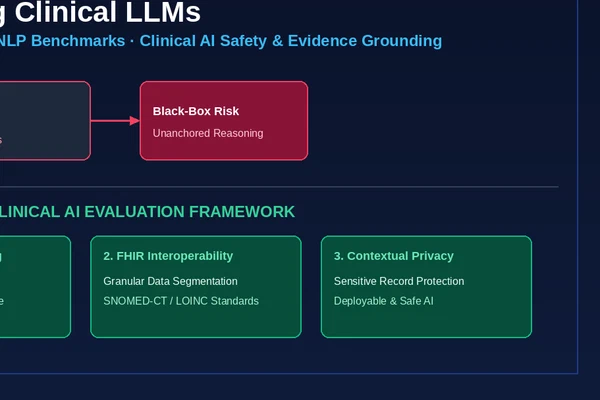
Evaluating Clinical LLMs: Beyond Standard NLP Benchmarks
Why general LLM benchmarks like MMLU or GSM8K fall short in medicine, and how evidence grounding, hallucination bounds, and FHIR interoperability redefine clinical AI safety.
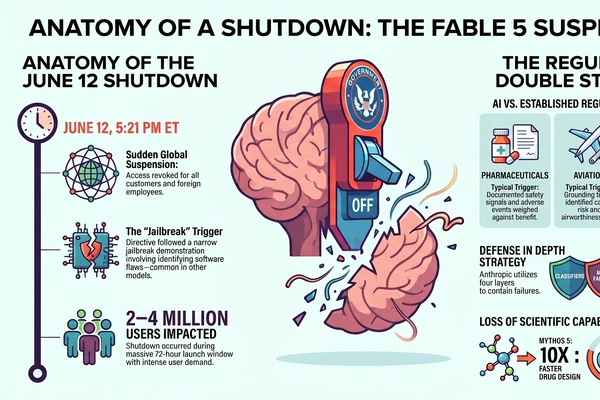
Anthropic’s Fable Suspension Is a Preview of Every Health-Tech AI Team’s Worst Nightmare
Anthropic’s Fable 5 suspension shows why health-tech AI needs due process, lifecycle governance, validated fallbacks, and risk-based regulation—not opaque shutdowns over imperfect models.